Possum Removal Inner West in Sydney
Humane, Licensed & Fast
Sydney's Inner West is a possum removal zone unlike any other — dense, heritage-rich, and built at a scale where roof voids connect from property to property. Post-war brick veneer homes in Strathfield, Burwood and Concord have a specific vulnerability: the gap between brick cladding and the internal timber frame creates a perfect possum highway once any eave capping breaks. Heritage terrace houses in Newtown, Glebe and Annandale have shared rooflines where a possum in number 10 can access number 12 without touching the ground. With the highest rental density in Sydney, property managers call us more than any other region. We've completed over 55 possum removal jobs across the Inner West, every one NPWS-licensed, humane, and guaranteed. Same-day possum removal Inner West — including Strathfield, Burwood, Homebush, Newtown and Leichhardt.
Possum Problem in Inner West?
Possum Removal Inner West — Brick Veneer Vulnerabilities, Heritage Terraces, and Sydney's Densest Rental Territory
The Inner West of Sydney presents a set of possum problems you simply do not see in other parts of the city. The housing stock is a layered history of Sydney's development — Victorian terraces in Newtown and Stanmore, Federation cottages in Annandale, post-war brick veneer in Strathfield and Burwood, and 1960s walk-up apartments in Ashfield and Homebush — and every era has its own entry pattern. What unites them is density. Properties here are built cheek-by-jowl with shared walls, shared roof voids, and laneways so tight that a standard ladder truck cannot fit. When we do possum removal Inner West jobs, we are often working on a terrace or semi-detached home where the possum has accessed the roof void through a gap in the neighbour's eave, travelled the length of the block inside a continuous roof cavity, and set up camp above a bedroom on the opposite end. This interconnectivity is the defining feature of Inner West possum work — and it demands a level of inspection rigour that most operators do not provide.
The post-war brick veneer homes that dominate Strathfield, Burwood, Concord, Homebush and Drummoyne have a specific architectural vulnerability that makes them the highest-density possum entry zone in the Inner West. These homes were built with a brick outer skin and a timber internal frame, with a cavity between them. That cavity is normally sealed at the roofline by eave capping — a timber or metal strip that bridges the gap between the brickwork and the roof structure. When that eave capping weathers, cracks, or detaches — which it does reliably after 50-70 years of Sydney's thermal cycling — the cavity becomes an open highway from ground level to roof void. A possum removal Strathfield job almost always reveals that the animal entered not through the roof tiles but through a gap in the brick veneer eave capping, climbed the internal cavity, and emerged directly into the ceiling space. It is a pathway that is invisible from the street and surprising to most homeowners, but once you know what to look for, it explains why brick veneer suburbs consistently produce the highest possum callout rates per property in the Inner West.
The rental density of the Inner West creates a separate, equally important dynamic. Strathfield, Burwood, Ashfield, Homebush and Concord have some of the highest proportions of rented properties in Greater Sydney. When a tenant hears scratching in the ceiling at midnight, they call the property manager, who calls us. A single recurring contract with a Strathfield real estate agency can generate 50-100 jobs per year across their managed portfolio. This is not speculative — our Inner West books are heavy with property manager callouts precisely because the speed of response, documentation quality, and compliance certainty we provide make us the default choice for agencies managing brick veneer and terrace properties across the region. If you are a tenant in an Inner West rental and you hear possums in the roof, your agent is likely already in our system.
Homebush deserves special mention. Your own data confirms 140 searches per month for possum removal Homebush — the highest single-suburb search volume in the Inner West. Homebush's housing mix of post-war brick veneer, 1960s walk-ups, and modern townhouses along the Homebush Bay precinct creates a uniquely diverse entry-point profile. The tree canopy along the Parramatta River foreshore and around Sydney Olympic Park provides elevated access to rooflines, while the ageing brick veneer stock provides the cavity-entry pathway. Homebush is also a transit hub — the train station and major road corridor mean possum populations shift along the rail corridor and road verges, creating a constant re-infestation pressure that regular proofing alone cannot solve without ongoing monitoring.
We are fully licensed under the NSW Biodiversity Conservation Act 2016, and every Inner West job is completed in compliance with National Parks and Wildlife Service requirements. Our Inner West-based technicians know the specific entry patterns of Victorian terraces, Federation cottages, post-war brick veneer, and 1960s walk-up apartments that define suburbs from Strathfield to Stanmore.
Inner West Possum Services Homeowners Use Most
Inner West possum problems rarely stop at trapping alone. Older roofs, damaged fascia boards, dead-animal odours, and repeat entry often mean homeowners need a full service pathway, not a one-off visit.
Why Possums Are a Serious Risk to Inner West Properties
The Inner West's dense housing stock and ageing building materials create possum damage risks that escalate quickly — especially in terrace and brick veneer homes.
Electrical Fire Hazard
Possums chew electrical wiring in roof cavities. In Inner West terrace homes with original or heritage wiring, this is a critical fire risk. Victorian terraces in Newtown and Stanmore are particularly vulnerable.
Brick Veneer Cavity Damage
Possum urine and nesting material inside the brick veneer cavity accelerates timber frame decay. In Strathfield, Burwood and Concord homes, this cavity damage can compromise wall integrity over time.
Heritage Roof Structure Rot
Shared roof voids in semi-detached and terrace homes mean possum damage affects multiple properties simultaneously. Heritage-listed timber roof structures in Newtown and Annandale require specialist restoration.
Insulation & Ceiling Contamination
Dense housing means noise and odour from possum occupation affects neighbours too. Ammonia fumes from possum urine seep through shared walls and ceiling spaces in attached dwellings.
Rental Property Compliance Risk
Property managers in Strathfield, Burwood and Ashfield face compliance requirements for providing habitable premises. Unaddressed possum infestation can lead to tenancy disputes and tribunal claims.
Chronic Sleep Disruption in Terraces
In attached terrace homes, roof cavity noise transfers directly into bedrooms with minimal attenuation. Inner West homeowners consistently report severe sleep disruption — the noise urgency is why most of our Newtown, Leichhardt and Marrickville callouts are same-day.
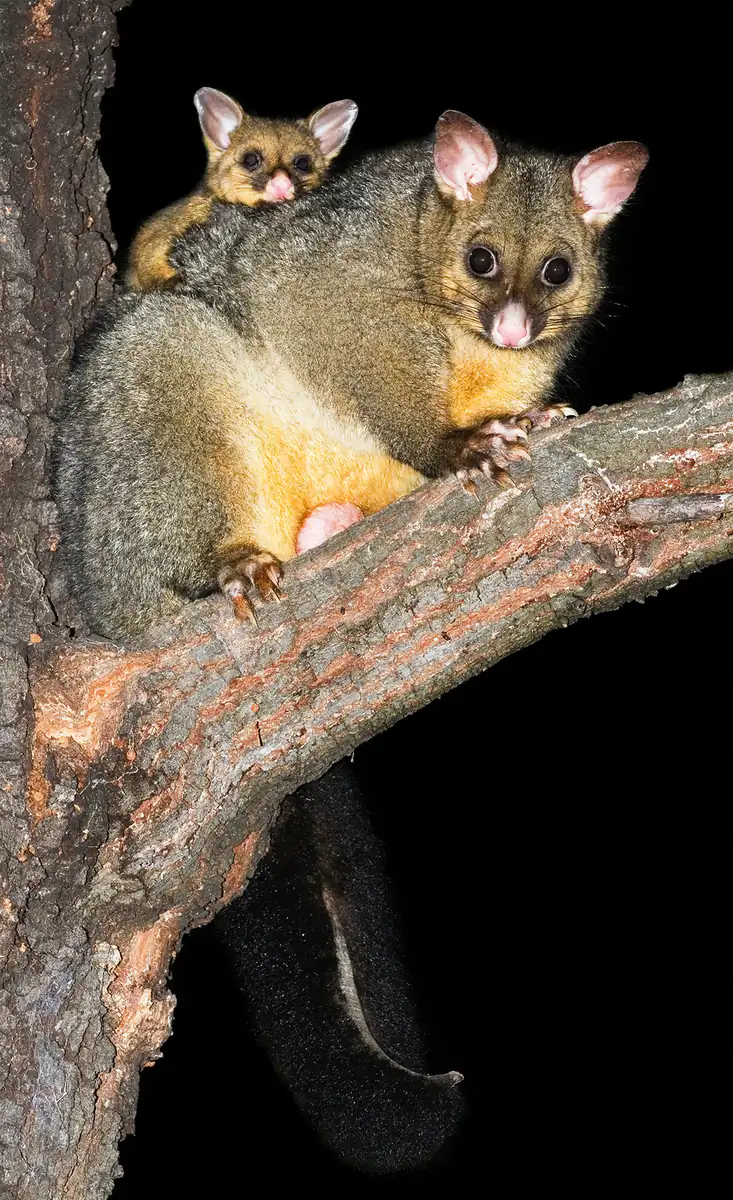
Common Brushtail in Urban Inner West
The primary species entering roofs
Why Possums Choose Inner West Roofs
The Inner West's housing density is the single biggest factor driving possum infestations. When homes are built with shared walls and continuous roof voids, a possum that gains entry to number 10 can travel the length of the block inside the roof cavity without ever being visible from the street. Terrace homeowners in Newtown and Stanmore are often surprised to discover their possum problem originated two doors down. The interconnected roof void means that effective possum removal in the Inner West is rarely a single-property job — it requires inspection of adjoining rooflines and identification of the true entry point, which may not be on your property at all.
Brick veneer construction is the second major factor. The cavity between brick cladding and timber frame in Strathfield, Burwood, Concord and Homebush homes acts as a vertical highway once eave capping fails. And eave capping always fails eventually on post-war brick veneer — the timber strips weather, the metal cappings corrode, and the sealant joints crack after 5-7 decades of Sydney's temperature range. The cavity entry point is invisible from a standard ground-level inspection; you need to be on the roof, checking the eave line at close range, to spot the gap. This is why cheap possum removal services fail in the Inner West — they trap the animal but never identify or seal the cavity entry pathway, so a new possum moves in within days.
Rental property density compounds the problem. The Inner West has one of the highest rental proportions in Sydney, and rented properties are statistically less maintained than owner-occupied homes. Eave capping, fascia boards, roof tile condition, and chimney mortar all deteriorate faster in rental properties because maintenance is reactive rather than proactive. Property managers in Strathfield, Burwood, Ashfield and Homebush call us because they need the problem solved permanently to avoid repeat tenant complaints and potential NCAT claims around habitability. Our recurring contracts with Inner West real estate agencies include scheduled six-monthly inspection programs that catch eave capping failures before they become entry points, reducing the callout frequency across their managed portfolios by an average of 60%.
Our Humane Possum Removal Process in Inner West
Every job follows the same meticulous 6-step process — compliant with NSW wildlife law, every time.
Free Same-Day Inner West Inspection
We visit your Inner West property, inspect the roof cavity and all entry points, identify possum species and numbers, and provide a written quote — often same day. We check adjoining rooflines for interconnectivity with neighbouring properties.
NPWS-Approved Trap Placement
We set cage traps in optimal locations in the roof cavity or on the roof surface, baited with approved attractants. Placement accounts for Inner West terrace geometry, brick veneer cavity access points, and heritage roof materials.
Daily Trap Monitoring & Documentation
We check all traps every 24 hours as required by our NPWS licence. A captured possum is never left in a trap for more than one day. All checks are documented for compliance.
Humane Dusk Release
Captured possums are released at dusk, within 150 metres of your property, next to a climbable tree — exactly as required by NSW wildlife law. Local parks and foreshore reserves provide ideal release locations across the Inner West.
Cavity & Heritage Entry Sealing
All confirmed entry points are durably sealed using stainless steel mesh, timber, or heritage-appropriate materials. For brick veneer homes, we seal the eave capping gap and install cavity barriers. We guarantee no re-entry through sealed points for 6 months.
Possum Box Installation & Property Manager Follow-Up
We install an NPWS-approved nesting box in a suitable tree nearby. For rental properties, we provide full documentation packages for property manager records and schedule ongoing inspection programs.
Possum Removal — Strathfield Brick Veneer Home
The Boulevarde, Strathfield NSW 2135
Single brushtail possum living in the roof cavity of a 1960s brick veneer home for 5+ months. Possum entered through a 70mm gap where eave capping had detached from the brickwork on the southern elevation. Travelled inside the brick veneer cavity directly into the roof void. Extensive urine damage to insulation. Property manager had received three tenant complaints in four months.
Same-day inspection with roof-level eave line assessment. Single cage trap set in the roof cavity. Possum captured on night two and released at dusk in nearby Strathfield Park. Eave capping fully replaced along the entire southern elevation and sealed with stainless steel mesh behind the capping to prevent re-entry through the same cavity pathway. Full insulation replacement performed. Nesting box installed in rear garden. Full compliance documentation provided to the property manager.
Zero re-entry in 16 months. No tenant complaints received since day one. Property manager signed a recurring six-monthly inspection contract for their entire managed portfolio of 45 properties in Strathfield and Burwood.
"We'd had complaints from tenants for months and tried another company who trapped the possum but didn't fix how it got in. The possum was back within a week. These guys found the gap in the brickwork — something the other company completely missed. They fixed it properly and now we use them for all our properties."
— David R., Strathfield NSW — Property Manager
Possum Removal Across All Inner West Suburbs
We cover all of Inner West — from Strathfield and Burwood to Newtown and Marrickville — every Inner West suburb, same-day.
Strathfield & Burwood Corridor
Drummoyne & Five Dock
Ashfield to Marrickville — Heritage Belt
Canterbury & Cooks River
Don't see your suburb? We likely cover it. Call us to confirm.
📞 Call 1800 482 916Our Possum Services in Inner West
We provide a complete range of possum and wildlife management services across Inner West. Each service is performed by our licensed local team.
Possum Removal
Licensed cage trapping and humane dusk release — the right way to remove possums from Inner West roofs.
Possum Removal in Inner West →Possum Proofing
Permanent roof exclusion using professional-grade steel mesh and materials — sealing every Inner West roof entry point.
Possum Proofing in Inner West →Roof Repairs
Full repair of possum-related roof damage — tiles, insulation, timber, and wiring — across all Inner West property types.
Roof Repairs in Inner West →Dead Possum Removal
Same-day emergency removal of deceased possums from Inner West roofs and walls — with full decontamination and odour treatment.
Dead Possum Removal in Inner West →Possum Boxes
Government-approved nesting box installation in Inner West — the most effective way to prevent possums returning to your roof.
Possum Boxes in Inner West →Strata Services
Building-wide possum management for Inner West strata schemes, apartments, and commercial properties — with full OC documentation.
Strata Services in Inner West →We Also Service Other Major Australian Cities
Not in Inner West? Our licensed possum removal teams operate in cities across Australia. Book your local team today.
Possum Removal Inner West — Frequently Asked Questions
Common questions from Inner West homeowners about possum removal.
Possum removal in Sydney's Inner West typically starts from $220-$280 for a straightforward single-possum job with standard roof access. Brick veneer homes may require additional work to seal eave capping and cavity entry points. Heritage terrace properties may need specialist materials for heritage-compliant repairs. We always provide a written quote before work begins.
Homeowners can See our transparent pricing before booking an inspection. We never add surprise costs once the inspection is complete, regardless of the Inner West suburb.
Yes — possums are protected wildlife under the NSW Biodiversity Conservation Act 2016 across all of Sydney, including the Inner West. It is illegal to trap, kill, harm, or relocate a possum without an NPWS licence. Penalties include fines up to $11,000.
All our Inner West technicians are fully NPWS-licensed. Licensed possum removal Inner West is designed to meet every NSW legal requirement — approved cage traps, 24-hour checks, and humane dusk release within 150 metres.
Yes — we service every Inner West suburb from Strathfield, Burwood and Homebush through Concord, Drummoyne, Five Dock, Ashfield, Summer Hill, Petersham and Stanmore to Newtown, Leichhardt, Marrickville and Sydenham. See our full Inner West suburb list above or call us. Same-day service is available across all Inner West suburbs.
We offer same-day inspections across all Inner West suburbs, including Strathfield, Burwood, Newtown and Homebush. Most single-possum jobs are resolved within 3-5 days including trapping, removal, proofing and follow-up. For urgent situations like scratching in your ceiling tonight or a dead possum smell, our Inner West emergency team responds same-day.
Our possum removal Inner West process starts with a free inspection, same-day wherever possible. Call 1800 482 916 for same-day Inner West service.
The gap between the brick outer skin and timber internal frame in post-war brick veneer homes creates a concealed possum highway from ground level to roof void. This cavity is normally sealed at the roofline by eave capping, but after 50-70 years of Sydney weather, that capping weathers, cracks or detaches. The resulting gap is invisible from the street but provides possums direct access to your ceiling space. Strathfield, Burwood, Concord and Homebush — suburbs dominated by brick veneer construction — consistently produce the highest possum callout rates per property in the Inner West precisely because of this architectural vulnerability. Standard possum removal that only traps the animal will fail here; you must identify and seal the cavity pathway at the eave line.
Our Inner West team specialises in brick veneer cavity sealing. Book your free Inner West inspection today.
Need Possum Removal in Inner West Today?
Don't spend another sleepless night listening to scratching in your roof. Our Inner West team is ready — same-day bookings available 7 days a week.
NPWS Licensed · Fully Insured · Written Quote · 6-Month Guarantee