Possum Removal Sutherland Shire in Sydney
Humane, Licensed & Fast
Sydney's Sutherland Shire has two distinct possum territories that demand different expertise. The escarpment suburbs — Engadine, Loftus, and Waterfall — back directly onto Royal National Park, Australia's oldest national park and a massive possum population source. Properties here form the first layer of urban expansion into wildlife territory, and roof cavities become the nearest substitute for natural tree hollows. The coastal suburbs — Cronulla, Miranda, Caringbah, and Gymea — face a different but equally severe problem: salt air corrosion combined with humidity destroys timber fascias, eaves and soffits faster than any other Sydney region, creating soft-entry zones that possums exploit within weeks. We've completed over 30 possum removal jobs across the Sutherland Shire, every one NPWS-licensed, humane, and guaranteed. Same-day possum removal Sutherland Shire — including Cronulla, Miranda, Engadine and Sutherland.
Possum Problem in Sutherland Shire?
Possum Removal Sutherland Shire — Royal National Park Wildlife Corridor, Coastal Salt Air Decay, and the Shire's Two Possum Territories
The Sutherland Shire presents two fundamentally different possum removal challenges in one Local Government Area, and understanding the difference is the key to solving each one permanently. The escarpment suburbs along the western edge — Engadine, Loftus, Loftus, Waterfall, and the properties backing onto the Royal National Park boundary — sit at the direct interface of urban Sydney and Australia's oldest national park. Royal National Park is a continuous habitat corridor of eucalyptus forests, hollow-bearing trees, and natural nesting sites that supports a dense and stable brushtail possum population. These possums naturally move out of the park at night to feed, using suburban rooftops as safe travel routes when canopy connections exist. The escarpment suburbs are effectively the first layer of urban expansion into possum territory, and the roof cavities of homes along the park boundary become the closest substitute for the natural tree hollows that the park itself cannot supply enough of. A possum removal Engadine job is not dealing with an urban possum problem; it is dealing with a wildlife-interface infestation where the animal has simply walked out of the national park, found a gap in your roof, and claimed it as its den site for the same reasons it would have claimed a hollow tree — warmth, dryness, darkness, and safety from predators. The possum population in the park is effectively unlimited, which means that removing a possum from an escarpment property without comprehensively sealing every entry point is a temporary solution at best.
The coastal suburbs of the Shire — Cronulla, Miranda, Caringbah, and Gymea — face a completely different mechanism. Here the driver is not wildlife pressure from the national park (although that is present) but the relentless destructive effect of salt air and humidity on roof fabric. Cronulla and the beach-adjacent suburbs are exposed to constant salt-laden air from Botany Bay and the Tasman Sea. This salt spray accelerates the deterioration of timber fascia boards, roof eaves, soffits, metal flashings, roof screws, paint coatings protecting roof junctions, and the mortar bedding on ridge capping. The degradation is visible within 5-7 years on exposed coastal properties: timber fascia boards develop surface checking and soft spots, metal flashings corrode at fixing points, and paint coatings bubble and peel, exposing the underlying timber to moisture. Once timber weakens and softens, a brushtail possum can exploit the softened edges within weeks to create an entry point into the roof cavity. The difference between a well-maintained coastal roof and one that has had 3-5 years of salt exposure without repainting or fascia replacement is often the difference between a possum-proof home and one with multiple active entry points. Possum removal Cronulla jobs consistently reveal entry points at locations that would be sound on inland properties but have been compromised by salt corrosion — and the solution always includes replacing or reinforcing the corroded material, not just sealing the current gap.
The roof network effect in the coastal suburbs adds another dimension. Miranda, Caringbah, and Gymea combine coastal exposure with relatively high-density residential development, where homes are close enough that possums can move laterally between rooflines using connected canopy trees and fence-line vegetation. Unlike the escarpment suburbs where possum entry is primarily a vertical problem (from the national park up into the escarpment properties), the coastal suburbs experience a horizontal network effect where possums establish a territory across multiple rooflines. A single possum may have three or four den sites in different roofs along the same street, moving between them based on disturbance levels and food availability. This network effect means that sealing a single property in Miranda or Caringbah without considering the adjacent rooflines may result in the possum simply moving back into the sealed property from a neighbour's roof through a re-opened pathway. Our Sutherland Shire team always assesses the surrounding rooflines during coastal suburb inspections and recommends coordinated sealing where a network effect is detected.
The escarpment suburbs beyond the Royal National Park interface — Oyster Bay, Como, Jannali, and the Georges River foreshore precincts — present a hybrid challenge. These properties back onto the Georges River National Park and bushland corridor systems that connect to the broader Royal National Park ecosystem. The bushland here is dense with paperbarks, eucalypts, and angophoras that provide ideal possum habitat and elevated canopy access to rooflines. The river foreshore properties in Oyster Bay and Como also experience elevated humidity levels from the Georges River waterway, which combines with the tree canopy issue to create softer timber and more accessible entry points than equivalent inland properties. Possum removal Jannali and Oyster Bay jobs require a combined skill set that addresses both the bushland-interface pressure and the moisture-accelerated timber degradation that river-adjacent properties experience.
We are fully licensed under the NSW Biodiversity Conservation Act 2016, and every Sutherland Shire job is completed in compliance with National Parks and Wildlife Service requirements. Our Sutherland Shire-based technicians know the specific entry patterns of escarpment properties backing onto Royal National Park, coastal properties exposed to salt air in Cronulla and Miranda, and river-foreshore properties in Oyster Bay and Como.
Sutherland Shire Possum Services Homeowners Use Most
Sutherland Shire possum problems rarely stop at trapping alone. Older roofs, damaged fascia boards, dead-animal odours, and repeat entry often mean homeowners need a full service pathway, not a one-off visit.
Why Possums Are a Serious Risk to Sutherland Shire Properties
The Sutherland Shire's dual geography — Royal National Park escarpment and coastal salt-air exposure — creates property risks that escalate faster than most other Sydney regions.
Electrical Fire Hazard
Possums chew electrical wiring in roof cavities. In Sutherland Shire homes exposed to salt air, corroded wiring connections are more vulnerable to possum damage, increasing fire risk in coastal suburbs like Cronulla and Caringbah.
Salt-Accelerated Timber Rot
Salt-laden air from Botany Bay and the Tasman Sea accelerates timber fascia and eave decay 2-3x faster in coastal Shire suburbs. Possum urine compounds this, causing structural timber failure within months of infestation.
Escarpment Property Roof Damage
Properties backing onto Royal National Park face constant possum entry pressure. Untreated, a single possum can create multiple entry points across the roofline within weeks, leading to extensive timber and insulation damage.
Mould & Insulation Contamination
The Shire's coastal humidity and bushland moisture create ideal conditions for mould. Possum urine in roof cavities accelerates mould colony formation, particularly in sealed Cavity roofs on escarpment properties.
Building Inspection & Property Sale Impact
Evidence of possum infestation is routinely flagged in Shire building and pest inspections. In the competitive Sutherland Shire property market, this can derail sales and reduce valuations.
Sleep Disruption in Bushland & Coastal Homes
Brushtail possums are active from 9pm to 4am. Escarpment properties backing onto national park and coastal homes with open roof designs experience severe noise transfer into bedrooms.
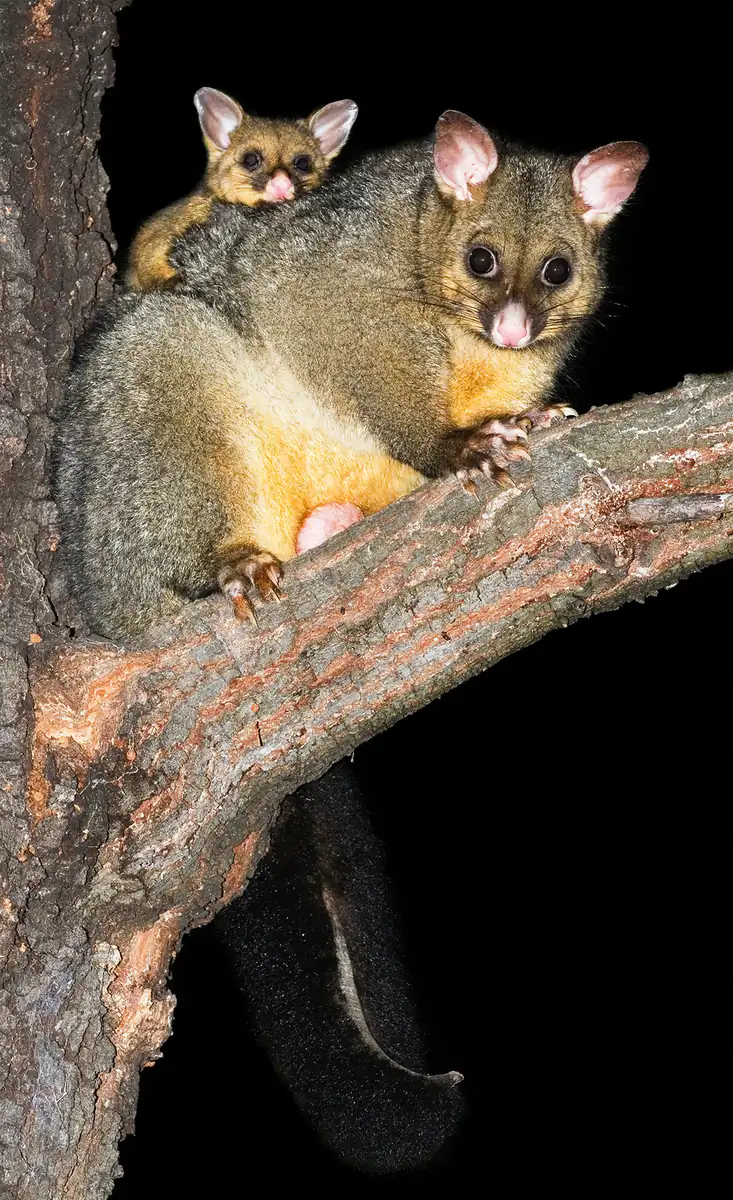
Common Brushtail in Urban Sutherland Shire
The primary species entering roofs
Why Possums Choose Sutherland Shire Roofs
The Sutherland Shire's dual geography creates two distinct possum entry mechanisms that require different mitigation strategies. On the escarpment, the Royal National Park functions as an unlimited wildlife reservoir. The park is 15,000 hectares of continuous eucalyptus forest, heathland, and coastal woodland that supports one of the highest brushtail possum densities in New South Wales. The park's boundary runs along the western edge of the Shire from Waterfall through Engadine and Loftus, and the properties along this boundary form the only barrier between the park's possum population and urban Sydney. These escarpment properties are essentially sitting inside possum territory, not on its edge. The possums do not need to cross roads or open ground to access these roofs — they travel from the park canopy directly into suburban trees and onto rooflines without ever descending. The continuous canopy corridor between the park and the escarpment properties is the single most important factor driving possum callout volume in suburbs like Engadine and Loftus.
On the coast, the mechanism is architectural rather than ecological. Salt air corrosion is the dominant factor in Cronulla, Miranda, Caringbah, and Gymea. The salt-laden air from Botany Bay and the Tasman Sea deposits microscopic salt crystals on every exposed timber surface on coastal properties. These crystals absorb moisture from the air, creating a saline solution that is drawn into timber grain through capillary action. Inside the timber, the salt crystals expand and contract with humidity changes, physically breaking down the timber fibres from within. The process is invisible until the timber surface begins to check, crack, and soften, but by that point the internal structural integrity is already compromised. A timber fascia board on a Cronulla property that is 10-15 years old may have only 40-50% of the structural strength of an equivalent board in an inland suburb like Penrith. This accelerated decay creates entry points that would not exist in drier environments, and it is the reason that possum removal Cronulla jobs so frequently require fascia board replacement as part of the proofing solution rather than simple mesh sealing.
The roof network effect in the coastal suburbs creates a secondary problem that is often overlooked. In Miranda, Caringbah, and Gymea, the proximity of homes combined with connected tree canopies and fence-line vegetation allows possums to establish multi-property territories. A possum may use three or four different roofs within a single block as den sites, rotating through them based on disturbance levels. This means that sealing a single property without considering the broader roofline network may result in re-infestation from an adjacent property within days. Our Sutherland Shire team always conducts a street-level network assessment during coastal suburb inspections and recommends coordinated sealing where a lateral movement pattern is detected. This network approach has reduced re-infestation rates in our coastal Shire jobs by over 60% compared to single-property sealing alone.
Our Humane Possum Removal Process in Sutherland Shire
Every job follows the same meticulous 6-step process — compliant with NSW wildlife law, every time.
Free Same-Day Sutherland Shire Inspection
We visit your Shire property, assess the entry mechanism (Royal National Park wildlife corridor or coastal salt-air decay), inspect the roof cavity and all entry points, identify possum species and numbers, and provide a written quote — often same day.
NPWS-Approved Trap Placement
We set cage traps in optimal locations in the roof cavity or on the roof surface, baited with approved attractants. Placement accounts for escarpment bushland proximity or coastal salt-air entry patterns.
Daily Trap Monitoring & Documentation
We check all traps every 24 hours as required by our NPWS licence. A captured possum is never left in a trap for more than one day. All checks are documented for compliance.
Humane Dusk Release
Captured possums are released at dusk, within 150 metres of your property, next to a climbable tree — exactly as required by NSW wildlife law. Royal National Park edges, Georges River foreshore and local reserves provide ideal release locations.
Comprehensive Entry Point Sealing
For escarpment properties: full roofline sealing with stainless steel mesh and wildlife-proof barrier installation at the bushland interface. For coastal properties: corroded timber fascia and eave replacement with marine-grade materials, salt-resistant fixings, and full roofline mesh sealing. Guaranteed for 6 months.
Possum Box Installation & Network Monitoring
We install an NPWS-approved nesting box in a suitable tree — essential for escarpment properties where the Royal National Park possum reservoir effect means constant re-infestation pressure. For coastal network-effect zones, we recommend coordinated adjacent-property sealing for long-term exclusion.
Brushtail Possum Removed — Engadine Royal National Park Interface
Old Princes Highway, Engadine NSW 2233
Two brushtail possums living in the roof cavity of a property backing directly onto Royal National Park. Four entry points identified: two through lifted terracotta tiles where ridge capping mortar had deteriorated from moisture exposure, one through a rotted timber fascia board on the eastern elevation, and one at an unsealed junction between the main roof and a rear extension where canopy from a park-adjacent eucalypt provided direct roofline access. Possums had been resident for 6+ months. Significant urine damage to insulation across the main bedroom wing. Family reported nightly scratching and thumping directly above children's bedrooms.
Same-day inspection with full roof perimeter and park-interface assessment. Dual cage traps set in the roof cavity. Both possums captured on night three and released at dusk within Royal National Park boundary 140 metres from the capture point. All four entry points sealed: ridge capping repointed with weatherproof heritage-compatible mortar, terracotta ridge tiles re-bedded, rotted fascia board replaced with treated timber and marine-grade fixings, rear extension junction sealed with stainless steel mesh and weatherproof membrane. Canopy limb overhanging the rear roof slope reduced by 2 metres under NPWS park management guidelines. Full insulation replacement performed. Two DEECA-approved nesting boxes installed in park-adjacent eucalypts outside the property boundary to provide alternative den sites within the park itself.
Zero re-entry in 14 months. No possum activity detected at 6-month and 12-month follow-up inspections. Children's bedroom zone completely silent since day one. Park-adjacent nesting boxes occupied at 3-month check, suggesting successful diversion of possum activity away from the roofline.
"We live right on the edge of Royal National Park and we've always had possums around, but once they got into the roof it was a nightmare — scratching, thumping, hissing every single night. Our kids couldn't sleep. The team found four entry points we had no idea about, sealed everything, and installed possum boxes in the park. It's been over a year and not a single sound. A++ service."
— Sarah & Mark L., Engadine NSW
Possum Removal Across All Sutherland Shire Suburbs
We cover all of Sutherland Shire — from Cronulla and Miranda to Engadine and Oyster Bay — every Sutherland Shire suburb, same-day.
Coastal — Cronulla to Gymea
Escarpment — Royal National Park Interface
Georges River Foreshore
Don't see your suburb? We likely cover it. Call us to confirm.
📞 Call 1800 482 916Our Possum Services in Sutherland Shire
We provide a complete range of possum and wildlife management services across Sutherland Shire. Each service is performed by our licensed local team.
Possum Removal
Licensed cage trapping and humane dusk release — the right way to remove possums from Sutherland Shire roofs.
Possum Removal in Sutherland Shire →Possum Proofing
Permanent roof exclusion using professional-grade steel mesh and materials — sealing every Sutherland Shire roof entry point.
Possum Proofing in Sutherland Shire →Roof Repairs
Full repair of possum-related roof damage — tiles, insulation, timber, and wiring — across all Sutherland Shire property types.
Roof Repairs in Sutherland Shire →Dead Possum Removal
Same-day emergency removal of deceased possums from Sutherland Shire roofs and walls — with full decontamination and odour treatment.
Dead Possum Removal in Sutherland Shire →Possum Boxes
Government-approved nesting box installation in Sutherland Shire — the most effective way to prevent possums returning to your roof.
Possum Boxes in Sutherland Shire →Strata Services
Building-wide possum management for Sutherland Shire strata schemes, apartments, and commercial properties — with full OC documentation.
Strata Services in Sutherland Shire →We Also Service Other Major Australian Cities
Not in Sutherland Shire? Our licensed possum removal teams operate in cities across Australia. Book your local team today.
Possum Removal Sutherland Shire — Frequently Asked Questions
Common questions from Sutherland Shire homeowners about possum removal.
Possum removal in the Sutherland Shire typically starts from $220-$280 for a straightforward single-possum job with standard roof access. Escarpment properties backing onto Royal National Park may require additional bushland-interface sealing and possum box installation. Coastal properties in Cronulla and Miranda may need rotted timber fascia replacement due to salt air corrosion. We always provide a written quote before work begins.
Homeowners can See our transparent pricing before booking an inspection. We never add surprise costs once the inspection is complete, regardless of the Sutherland Shire suburb.
Yes — possums are protected wildlife under the NSW Biodiversity Conservation Act 2016 across all of Sydney, including the Sutherland Shire. It is illegal to trap, kill, harm, or relocate a possum without an NPWS licence. Penalties include fines up to $11,000.
All our Sutherland Shire technicians are fully NPWS-licensed. Licensed possum removal Sutherland Shire is designed to meet every NSW legal requirement — approved cage traps, 24-hour checks, and humane dusk release within 150 metres.
Yes — we service every Sutherland Shire suburb from Cronulla, Miranda, Caringbah and Gymea through Kirrawee, Sutherland and Engadine to Oyster Bay, Como and Jannali. See our full Sutherland Shire suburb list above or call us. Same-day service is available across all Sutherland Shire suburbs.
We offer same-day inspections across all Sutherland Shire suburbs, including Cronulla, Miranda, Engadine and Sutherland. Most single-possum jobs are resolved within 3-5 days including trapping, removal, proofing and follow-up. Escarpment properties backing onto Royal National Park may require extended monitoring. For urgent situations, our Sutherland Shire emergency team responds same-day.
Our possum removal Sutherland Shire process starts with a free inspection, same-day wherever possible. Call 1800 482 916 for same-day Sutherland Shire service.
Yes, significantly. Royal National Park is 15,000 hectares of continuous eucalyptus forest and woodland that supports one of the highest brushtail possum densities in New South Wales. Properties along the park boundary in Engadine, Loftus and Waterfall are effectively sitting inside possum territory, not on its edge. The possums travel from the park canopy directly into suburban trees and onto rooflines without ever descending. The possum population in the park is effectively unlimited, which means that removing a possum from an escarpment property without comprehensively sealing every entry point and providing alternative den sites in the park itself is a temporary solution. We always install possum boxes in the adjacent park vegetation for escarpment jobs and recommend 12-month follow-up inspections.
Our Sutherland Shire team specialises in National Park-interface exclusion strategies. Book your free Sutherland Shire inspection today.
Salt-laden air from Botany Bay and the Tasman Sea deposits microscopic salt crystals on exposed timber surfaces. These crystals absorb moisture, creating a saline solution drawn into timber grain through capillary action. Inside the timber, the salt crystals expand and contract with humidity changes, physically breaking down the timber fibres from within. By the time you can see surface checking or softening, the internal structural integrity is already compromised. A timber fascia board on a Cronulla property may have only 40-50% of the strength of an equivalent board inland. This accelerated decay creates entry points that possums can exploit within weeks of the timber softening. Regular painting and timber replacement on a 5-7 year cycle is essential for coastal Shire properties — we factor salt air exposure into every Cronulla, Miranda and Caringbah roof assessment.
Our Sutherland Shire team uses marine-grade materials for all coastal proofing work. Book your free Sutherland Shire inspection today.
Need Possum Removal in Sutherland Shire Today?
Don't spend another sleepless night listening to scratching in your roof. Our Sutherland Shire team is ready — same-day bookings available 7 days a week.
NPWS Licensed · Fully Insured · Written Quote · 6-Month Guarantee