Possum Removal Inner Melbourne in Melbourne
Humane, Licensed & Fast
Melbourne's inner suburbs — South Yarra, St Kilda, Hawthorn, Fitzroy, Richmond, Kew, Camberwell, Toorak and more — combine the oldest housing stock in the city with the densest tree canopy, creating constant possum pressure on heritage roofs and apartment blocks alike. Victorian terraces with original eave linings, weatherboard workers' cottages, and strata-managed apartment towers each present a different entry pattern, and the heritage overlays that protect much of this housing demand proofing that preserves original fabric. We've completed over 45 possum removal jobs across inner Melbourne, every one DEECA-licensed, humane, and guaranteed. Same-day possum removal inner Melbourne — including South Yarra, St Kilda, Hawthorn and Richmond.
Possum Problem in Inner Melbourne?
Possum Removal Inner Melbourne — Heritage Roofs, Shared Walls, and the City's Densest Possum Territory
Melbourne's inner ring is the oldest continuously built-up part of the city, and its housing stock tells the whole story of Victorian building practice. South Yarra, St Kilda, Hawthorn, Kew and Richmond are packed with Victorian terraces, Edwardian semis, Californian bungalows and weatherboard workers' cottages built between 1850 and 1940 — most with original timber eave linings, cast-iron lacework and slate or terracotta roofs that were never designed to keep wildlife out. After 150 years of thermal cycling and Melbourne's rapid temperature swings, these roofs develop hairline cracks, separated fascias and rotted barge boards that a brushtail possum exploits in a single night. Inner Melbourne possum removal is as much about understanding heritage construction as it is about trapping the animal.
Density is the defining feature. Unlike the outer suburbs, inner Melbourne homes are built cheek-by-jowl, often sharing party walls and continuous roof voids. A possum that enters a terrace in Richmond can travel the length of the block inside the roof cavity and set up camp above a bedroom three houses down. This interconnectivity means effective removal is rarely a single-property job — we map the shared void, confirm which side of the wall the noise is actually on, and seal the true entry point rather than the symptom. It also means the 6-month re-entry guarantee matters more here than anywhere else: a job is only finished when the whole roofline is closed, not just the hole above your own ceiling.
The apartment stock adds a second layer. South Yarra, St Kilda, Melbourne CBD and Collingwood contain thousands of apartment units in shared buildings where service risers, roof penetrations and wall cavities connect units to each other. A possum in one unit quickly becomes a building-wide issue as it moves between risers and voids — which is why our strata work in the inner suburbs is some of the heaviest in the state. Owners corporations call us because one resident's midnight scratching becomes a whole-building complaint, and the body corporate needs one report, one invoice and photos of every sealed point to close the matter properly.
Heritage overlays complicate every inner-Melbourne job. Suburbs like Fitzroy, Carlton, Collingwood, Richmond, South Yarra, Hawthorn, Malvern and St Kilda sit inside Heritage Overlay controls under the Victoria Planning Provisions. You cannot simply rip out rotted timber or replace original ridge capping with modern materials on a protected home. Our proofing in these areas uses reversible methods wherever possible — stainless steel mesh fitted without damaging original fabric, lime-compatible repointing of chimneys, and careful fascia repair that preserves the streetscape. This keeps your home compliant with council heritage requirements while permanently closing the possum access route.
Finally, the tree canopy. Inner Melbourne's famous plane-tree boulevards, plus the established gardens of Hawthorn, Kew, Camberwell, South Yarra and Toorak, form an unbroken elevated highway from park to roofline. Possums rarely need to touch the ground to travel from a garden tree to your ridge capping. Combined with the sheer age of the housing, this canopy is why the inner ring produces more possum callouts per property than any other part of Greater Melbourne — and why our response times here are the shortest in the city.
Inner Melbourne Possum Services Homeowners Use Most
Inner Melbourne possum problems rarely stop at trapping alone. Older roofs, damaged fascia boards, dead-animal odours, and repeat entry often mean homeowners need a full service pathway, not a one-off visit.
Why Possums Are a Serious Risk to Inner Melbourne Properties
Inner Melbourne's heritage housing stock and dense tree canopy create possum damage risks that escalate quickly — especially in terrace, weatherboard and strata properties.
Electrical Fire Hazard
Possums chew electrical wiring in roof cavities. In inner Melbourne terraces with original or cloth-wired electrical systems, this is an immediate fire risk — especially in Richmond, Fitzroy and Carlton.
Heritage Roof Structure Rot
Original timber eave linings on Victorian and Edwardian homes are already fragile after 150+ years. Possum movement and urine cause these to crumble, requiring heritage-approved restoration that is significantly more expensive than standard repairs.
Weatherboard & Fascia Damage
Possums gnaw at warped weatherboards, rotted barge boards and loose fascia junctions on inner Melbourne workers' cottages. In South Yarra and Hawthorn, urine-soaked timber can warp beyond repair within a single season.
Insulation & Ceiling Contamination
Dense housing means noise and odour from possum occupation affects neighbours too. Ammonia fumes from possum urine seep through shared walls and ceiling spaces in attached dwellings across Richmond and St Kilda.
Strata & Body Corporate Impact
In South Yarra, St Kilda and CBD apartment towers, a possum in the roof void becomes a building-wide issue. Owners corporations face repeated complaints, insurance questions and service-riser sealing costs if the job is not done properly.
Chronic Sleep Disruption
Brushtail possums are active from 9pm to 4am. In tightly packed terraces and flats, noise transfers directly from the roof cavity into bedrooms. Inner Melbourne homeowners are among our most frequent urgent callers for this reason.
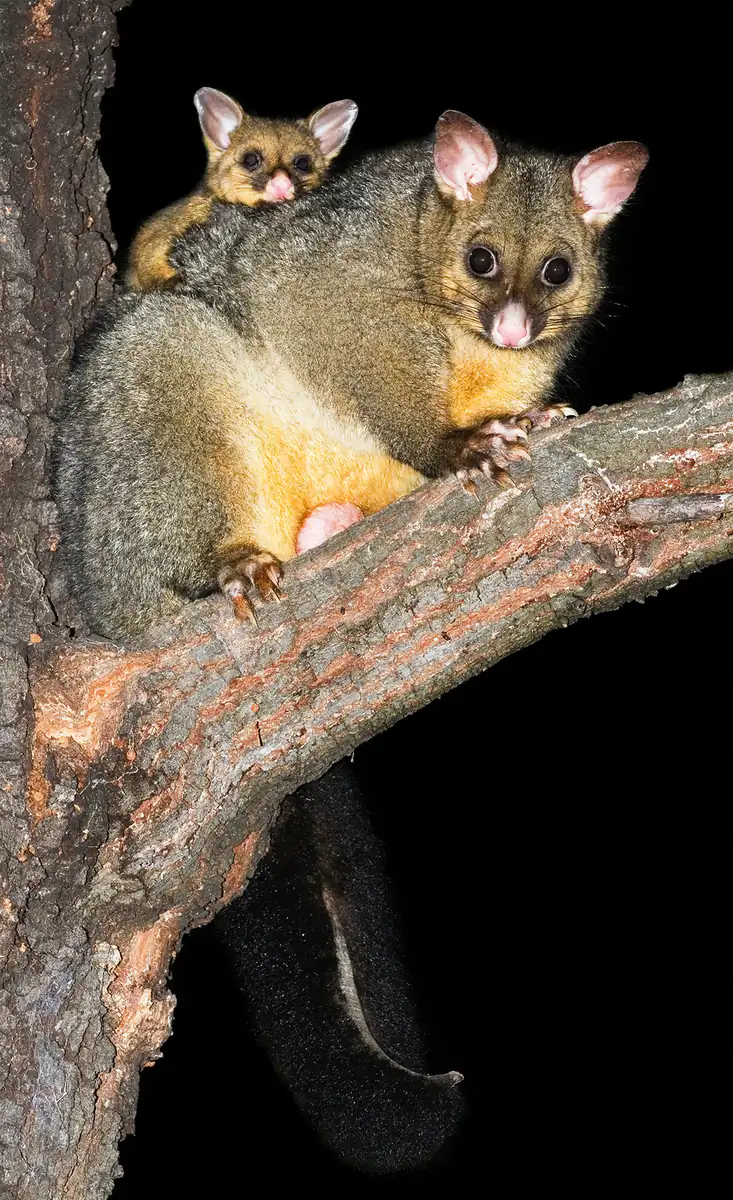
Common Brushtail in Urban Inner Melbourne
The primary species entering roofs
Why Possums Choose Inner Melbourne Roofs
The age of the housing stock is the single biggest factor driving inner Melbourne possum infestations. Unlike modern construction with sealed eaves and sarking, Victorian terraces and Edwardian homes have exposed timber, unsealed valley intersections and original chimneys with deteriorated mortar — every one a potential possum doorway. The city's inner ring has been accumulating entry points for over 150 years, and short of a full roof replacement, those weaknesses keep reappearing as materials age. Our proofing jobs in the inner suburbs are built to match the era of the home: heritage-compatible sealing that closes today's entry points without creating a compliance problem for the owner.
Tree canopy is the second factor. The plane trees along St Kilda Road and Bridge Road, the established gardens of Hawthorn and Kew, and the parks scattered through South Yarra, Richmond and Fitzroy give possums a connected highway of elevated access points. A mature eucalypt or oak overhanging the roofline removes the need for a possum to ever touch the ground on its way to your eaves. We factor these access routes into every proofing job — sometimes the permanent fix involves recommending a targeted pruning (done with council approval where trees are protected) as well as sealing the roof itself.
Density and shared voids compound the problem. Because inner Melbourne homes share walls and roof spaces, an infestation is often a block-level problem rather than a single-home one. A possum that gains entry through a gap in one home's eave can move freely through the connected cavity network. This is why our inspections in Richmond, St Kilda and Hawthorn always include an assessment of the adjoining rooflines — the true entry point is frequently on a neighbouring property, and sealing only your own side leaves the problem to return. The guarantee we offer on every sealed point is our commitment that the whole roofline, not just your section of it, is closed.
Our Humane Possum Removal Process in Inner Melbourne
Every job follows the same meticulous 6-step process — compliant with Victoria wildlife law, every time.
Free Same-Day Inner Melbourne Inspection
We visit your inner Melbourne property, inspect the roof cavity and all entry points, identify possum species and numbers, and provide a written quote — often same day. We map shared voids and confirm which side of the wall the noise is on before anything is opened.
DEECA-Approved Trap Placement
We set cage traps in optimal locations in the roof cavity or on the roof surface, baited with approved attractants. Placement accounts for inner Melbourne terrace geometry, heritage tile type and apartment roof access.
Daily Trap Monitoring & Documentation
We check all traps every 24 hours as required by our DEECA licence. A captured possum is never left in a trap for more than one day, and every check is documented for compliance.
Humane Dusk Release
Captured possums are released at dusk, within 50 metres of your property, next to a climbable tree — as required by Victorian wildlife law. Inner Melbourne parks and garden trees provide suitable release locations.
Heritage-Appropriate Entry Sealing
All confirmed entry points are durably sealed using stainless steel mesh, timber, or heritage-appropriate repair materials matched to your property's era. For apartments, service risers and roof penetrations are closed for the whole building. We guarantee no re-entry through sealed points for 6 months.
Possum Box Installation & Follow-Up
We install a DEECA-approved nesting box in a suitable tree nearby, giving your resident possum a safe alternative home — making it far less likely to attempt re-entry into your inner Melbourne roof.
Brushtail Possum Removed — Richmond Victorian Terrace
Highett Street, Richmond VIC 3121
Single brushtail possum living in the roof cavity of a Victorian terrace for 6+ months. The noise travelled through the shared void into the neighbour's bedroom, triggering complaints from two properties. Four entry points identified through crumbling original timber eave linings, a deteriorated chimney flashing and a gap in the valley junction. Urine had soaked through the ceiling insulation in two rooms.
Same-day inspection with shared-roofline assessment. Single cage trap set in the roof cavity. Possum captured on night three and released at dusk in a nearby garden tree within 50 metres. All four entry points sealed with stainless steel mesh and heritage-matched timber. Chimney flashing re-bedded with lime-compatible mortar. Full insulation replacement performed. Nesting box installed in the rear garden oak.
Zero re-entry in 16 months. No noise or odour complaints from either property since day one. Follow-up inspection at 12 months confirmed all seals intact through a full Melbourne winter.
"We'd been hearing scratching for months and assumed it was the neighbour's problem — turns out it was in our shared roof. They mapped the whole thing, sealed every gap, and it's been silent ever since. The heritage materials they used look like they've always been there."
— Sarah M., Richmond VIC
Possum Removal Across All Inner Melbourne Suburbs
We cover all of Inner Melbourne — from the CBD and South Yarra to St Kilda, Hawthorn and Richmond — every inner Melbourne suburb, same-day.
CBD Fringe & North
Yarra Valley & Richmond
Stonnington & Toorak
Don't see your suburb? We likely cover it. Call us to confirm.
📞 Call 1800 482 916Our Possum Services in Inner Melbourne
We provide a complete range of possum and wildlife management services across Inner Melbourne. Each service is performed by our licensed local team.
Possum Removal
Licensed cage trapping and humane dusk release — the right way to remove possums from Inner Melbourne roofs.
Possum Removal in Inner Melbourne →Possum Proofing
Permanent roof exclusion using professional-grade steel mesh and materials — sealing every Inner Melbourne roof entry point.
Possum Proofing in Inner Melbourne →Roof Repairs
Full repair of possum-related roof damage — tiles, insulation, timber, and wiring — across all Inner Melbourne property types.
Roof Repairs in Inner Melbourne →Dead Possum Removal
Same-day emergency removal of deceased possums from Inner Melbourne roofs and walls — with full decontamination and odour treatment.
Dead Possum Removal in Inner Melbourne →Possum Boxes
Government-approved nesting box installation in Inner Melbourne — the most effective way to prevent possums returning to your roof.
Possum Boxes in Inner Melbourne →Strata Services
Building-wide possum management for Inner Melbourne strata schemes, apartments, and commercial properties — with full OC documentation.
Strata Services in Inner Melbourne →We Also Service Other Major Australian Cities
Not in Inner Melbourne? Our licensed possum removal teams operate in cities across Australia. Book your local team today.
Possum Removal Inner Melbourne — Frequently Asked Questions
Common questions from Inner Melbourne homeowners about possum removal.
Possum removal in Melbourne's inner suburbs typically starts from $220-$350 for a straightforward single-possum job with standard roof access. Heritage terraces with crumbling eave linings, weatherboard access issues, or jobs on apartment buildings may require additional proofing and roof repair work. We always provide a written quote before work begins.
Homeowners can see our transparent pricing before booking an inspection. We never add surprise costs once the inspection is complete, regardless of the inner Melbourne suburb.
Yes — possums are protected wildlife under Victoria's Wildlife Act 1975 across all of Melbourne, including the inner suburbs. It is illegal to trap, kill, harm, or relocate a possum without a current DEECA wildlife controller licence. Penalties include fines up to $10,000.
All our inner Melbourne technicians are fully DEECA-licensed. Licensed possum removal inner Melbourne is designed to meet every Victorian requirement — approved cage traps, 24-hour checks, and humane dusk release within 50 metres of the capture site.
Yes — we service every inner Melbourne suburb from the CBD, Carlton, Fitzroy and Collingwood through Richmond, Hawthorn, Kew, Camberwell, South Yarra, Toorak, Malvern, St Kilda and Elwood. See our full inner Melbourne suburb list above or call us. Same-day service is available across all inner suburbs.
We offer same-day inspections across all inner Melbourne suburbs, including South Yarra, Richmond, Hawthorn and St Kilda. Most single-possum jobs are resolved within 3-5 days including trapping, removal, proofing and follow-up. For urgent situations like scratching in your roof tonight or a dead possum smell, our inner Melbourne emergency team responds same-day.
Our possum removal inner Melbourne process starts with a free inspection, same-day wherever possible. Call 1800 482 916 for same-day inner Melbourne service.
Age of housing is the key difference. Inner Melbourne's Victorian and Edwardian housing stock is 130-170 years old, with original timber eave linings, slate and terracotta roofs, and deteriorated chimney mortar that give possums far more entry points than modern homes. Combined with the dense tree canopy and shared roof voids of attached housing, the inner ring presents the most urgent possum remediation environment in Greater Melbourne.
Our inner Melbourne-specific approach accounts for heritage materials, shared walls and apartment construction. Book your free inner Melbourne inspection today.
Need Possum Removal in Inner Melbourne Today?
Don't spend another sleepless night listening to scratching in your roof. Our Inner Melbourne team is ready — same-day bookings available 7 days a week.
DEECA Licensed · Fully Insured · Written Quote · 6-Month Guarantee