Possum Removal Melbourne
Humane, Licensed & Fast
Melbourne's trusted humane possum removal experts. Serving the inner suburbs, Bayside, the Dandenong Ranges, Mornington Peninsula, and outer growth corridors. DEECA-licensed technicians available 7 days, with same-day possum removal Melbourne homeowners can book fast across heritage homes, weatherboards, and tiled roofs.
Possum Problem in Melbourne?
Melbourne's #1 Humane Possum Removal Service
Melbourne's urban forest is one of the most extensive of any city in the southern hemisphere, and it supports one of Australia's densest urban possum populations. Tree-lined streets in Brighton, Camberwell, Hawthorn, Ivanhoe, Eltham, Kew, and Mornington create ideal feeding corridors, while older rooflines and eaves provide shelter close to food. That combination makes possum removal Melbourne-wide a year-round need rather than a seasonal issue.
The building stock is what truly separates Melbourne from Sydney. Inner and middle-ring suburbs are packed with weatherboard homes, timber verandahs, old soffits, and ageing eave linings that are far easier for possums to enter than brick construction. On inspection, we regularly find brushtail possums exploiting warped weatherboards, rotted barge boards, and loose fascia junctions in Fitzroy, Northcote, Brunswick, Hawthorn, Camberwell and Malvern. In Bayside suburbs like Brighton and in foothill suburbs like Eltham, the pattern is similar: older homes, dense canopy, and countless elevated access points.
Melbourne also has a more visible split between species. Common ringtail possums are especially active in Melbourne gardens, pergolas and dense shrubs, often nesting in drays close to houses rather than inside the roof itself. Brushtail possums, by contrast, are the species far more likely to break into roofs, ceiling voids and wall cavities. That difference matters because a homeowner hearing scratching in the roof usually has a very different problem from someone seeing ringtails stripping citrus trees or sheltering in a vine-covered fence line.
Possum Removal Pros has operated across Melbourne since 2019, completing over 130 possum removal jobs from the CBD to the Dandenong Ranges, Mornington Peninsula, Berwick corridor, and western growth areas like Hoppers Crossing. Our Melbourne team holds current Department of Energy, Environment and Climate Action wildlife licences, and every job is completed in compliance with Victoria's Wildlife Act 1975. We identify the species, map the entry path, trap and release legally, then recommend the right proofing or repair pathway so the issue does not return the next cold front.
Melbourne's climate magnifies every delay. Cold wet winters drive possums deeper into insulated roof spaces and keep them there longer, while hot dry summers make roof cavities harsh enough that the animals move noisily at night in search of exit points and water. That is why possum removal Brighton jobs often involve old tiled roofs, possum removal Mornington calls often combine coastal weather exposure with tree canopy, possum removal Eltham work often means garden and roof interaction, and possum removal Berwick or possum removal Hoppers Crossing bookings increasingly come from fast-growing estates where habitat loss has pushed wildlife into nearby homes.
Melbourne is one of Australia's most heritage-significant cities, with dozens of inner suburbs protected by Heritage Overlay controls under the Victoria Planning Provisions. Suburbs like Fitzroy, Carlton, Collingwood, Richmond, South Yarra, Hawthorn, Malvern, and St Kilda contain thousands of Victorian, Edwardian, and interwar homes where original roof fabric — slate, terracotta, timber, cast iron — is protected by council regulation. That creates a unique problem: you cannot simply rip out rotted timber or replace original ridge capping with modern materials when the home is heritage-listed. Our possum proofing work in heritage overlay areas uses reversible methods wherever possible — stainless steel mesh fitted without damaging original fabric, repointing using compatible lime mortar, and careful fascia repair that preserves the heritage streetscape. This approach keeps your home compliant with council heritage requirements while permanently solving the possum access problem.
Beyond the inner suburbs, Melbourne's rapid population growth has pushed suburban estates deep into former possum habitat. In growth corridors like Berwick, Cranbourne, Pakenham, Werribee, Point Cook, and Melton, new housing estates have been built on land that was until recently dense woodland or farmland. This habitat removal forces possums into the nearest available shelter — the roofs of newly built or recently completed homes. We are increasingly seeing new homeowners in these corridors call us within months of moving in, reporting scratching and thumping in roofs that are only a few years old. The pattern is consistent: the possum was displaced by construction, found a gap during the build, and settled in before the homeowner even arrived. Possum removal in these growth areas is now one of the fastest-growing parts of our Melbourne operation.
Melbourne Possum Services Homeowners Use Most
Melbourne possum problems rarely stop at trapping alone. Older roofs, damaged fascia boards, dead-animal odours, and repeat entry often mean homeowners need a full service pathway, not a one-off visit.
Possum Identification Guide for Melbourne Homeowners
Two species commonly invade Melbourne homes. Knowing which one you have helps us provide the right solution faster.
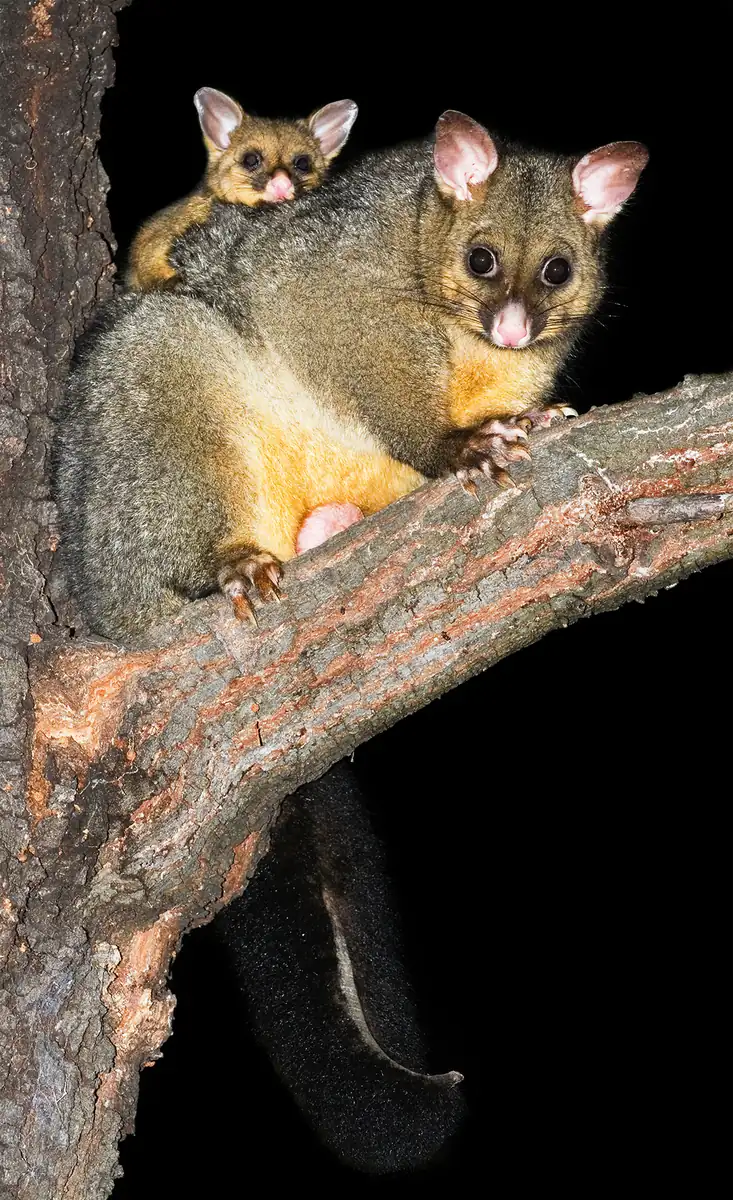
Common Brushtail Possum
Trichosurus vulpecula
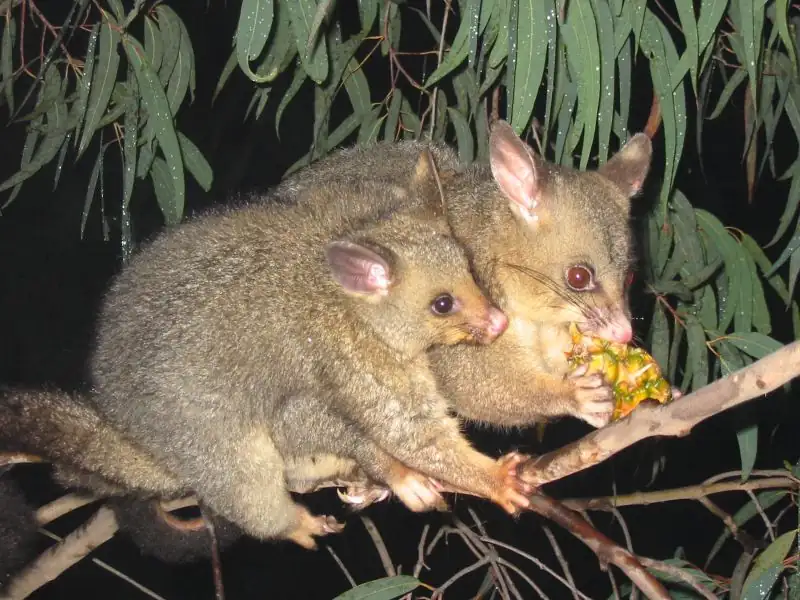
Common Ringtail Possum
Pseudocheirus peregrinus
Signs You Have a Possum in Your Melbourne Home
Possums are nocturnal, so you may not see them — but you'll definitely hear and smell them. Here's what to look and listen for in Melbourne homes.
Heavy thumping or running sounds
Particularly between 9pm and 4am. Brushtail possums are surprisingly heavy and loud when moving across ceiling joists.
Hissing, screeching or coughing sounds
Brushtails make guttural coughs and loud screeches, especially when disturbed or fighting for territory.
Yellow ceiling stains or ammonia smell
Possum urine soaks through insulation and into plasterboard, leaving brown-yellow stains and a strong, sharp ammonia odour.
Scratch marks on roof tiles or fascia boards
Entry and exit points are often marked with worn timber, broken tiles, or disturbed mortar — look for these at dusk.
Foul dead animal smell
A possum that has died inside your roof will create an intense odour within 48 hours. This requires urgent professional removal.
Damage to garden and fruit trees
Chewed leaves, stripped bark, half-eaten fruit — classic signs of possum foraging activity near your home each night.
🚨 Don't Ignore It
A possum in your roof is not just an annoyance. Left unaddressed, the damage escalates quickly. In Melbourne's climate, moisture from possum urine can cause mould, timber rot, and short-circuits within weeks.
Call Now — 1800 482 916The Real Cost of Doing Nothing
Why Possums Are a Serious Risk to Melbourne Properties
Melbourne's four-seasons-in-one-day climate creates unique challenges for properties with possums. Cold, wet winters combined with possum damage can cause serious structural issues faster than most homeowners realise.
Winter Insulation Damage
Melbourne's cold winters make roof insulation critical. Possum urine destroys insulation R-ratings and creates mould — causing sky-high heating bills and unhealthy indoor air quality.
Electrical Wiring Fire Risk
Possums love gnawing on plastic cable sheathing. In Melbourne's many pre-1970s homes, this creates a serious electrical fire risk that insurers take very seriously — and may void your policy.
Water Ingress & Mould
Melbourne's wet winters allow possum damage to roof tiles and flashings to create water ingress points. Mould colonies form rapidly in the wet insulation, spreading into living spaces.
Leptospirosis Risk
Possum urine contains Leptospira bacteria. In Melbourne's wet winters, urine can drip through ceiling cracks and contaminate surfaces in living areas — a serious health hazard.
Heritage Home Vulnerability
Melbourne has Australia's highest concentration of Victorian and Edwardian homes. Their original timber, slate, and terracotta materials are particularly vulnerable to possum damage and moisture from urine. Many inner-Melbourne suburbs are covered by Heritage Overlay controls, meaning any proofing or roof repair must use reversible methods that preserve original fabric.
Building Inspection Failure
Evidence of possum infestation is routinely flagged in Melbourne building and pest inspections. This can derail property sales and reduce your home's value in Melbourne's competitive market.
Common Brushtail in Urban Melbourne
The primary species entering roofs
Why Possums Choose Melbourne Roofs
Melbourne's urban possum population has grown dramatically over the past three decades, driven by suburban expansion into remnant habitat and the loss of mature hollow-bearing trees. Brushtail possums still need a dry, sheltered den close to feeding territory, so once natural hollows disappear, roofs and ceiling voids become the next best option.
Melbourne's mix of Victorian terraces, Californian bungalows, and Federation weatherboard homes provides ideal possum entry opportunities. Weatherboard homes are significantly easier for possums to enter than solid brick homes because timber shrinks, swells and gaps over time. Add cracked terracotta ridge caps, wet winter deterioration, and overhanging plane trees, and you get a city full of simple roof access pathways.
Neighbourhoods like Fitzroy, Richmond, Carlton, Hawthorn, Camberwell, Brighton, Eltham and Ivanhoe are particularly prone because they combine mature gardens, older roofs and established possum territories. But we also receive constant calls from Berwick, Mornington, Ringwood and Hoppers Crossing as growth corridors keep colliding with shrinking habitat.
Melbourne's fluctuating climate also plays a direct role in possum roof entry. During dry summer months, timber fascia boards, weatherboards, and eave linings shrink and pull back slightly, creating gaps that did not exist in winter. That desiccation cycle — expanding in wet winter, contracting in dry summer — gradually loosens roof elements over years. By the time a property is 20-30 years old, most weatherboard homes in Melbourne have at least one accessible route near the roofline. Regular roof maintenance helps, but many homeowners do not notice the gaps until a possum has already moved in.
Another factor specific to Melbourne is the prevalence of mature plane trees and liquidambars planted along streets in the inner and middle suburbs. These trees grow quickly and drop heavy limbs that can shift roof tiles on impact. More importantly, their canopy often extends directly over the roofline, giving possums a direct elevated pathway down onto the roof surface. In suburbs like Hawthorn, Camberwell, Malvern, Armadale, and Brighton, overhanging canopy is the single most common contributing factor we identify during initial inspections.
Possum Removal Laws in Victoria
In Victoria, possums are protected under the Wildlife Act 1975. It is illegal to trap, kill, or relocate a possum without a current wildlife controller licence issued by DEECA. That is a critical difference from Sydney-style NPWS licensing: Melbourne possum work is regulated through Victoria's wildlife authority, with its own documentation, handling, and release obligations. In Victoria, trapped brushtail possums must be released on the property where they were captured, no more than 50 metres from the capture site, after sunset on the day of capture. Failure to comply risks prosecution and fines of up to $10,000.
⚠️ Penalties for illegal possum removal in Victoria include fines up to $10,000. Always use a licensed operator.
DEECA Wildlife Licence
All possum trapping in Victoria requires a Wildlife Controller Licence from DEECA. Our entire Melbourne team is fully licensed and regularly audited.
24-Hour Release Rule
Victorian law requires captured possums to be managed and released within the legal timeframe. We check every trap daily and handle dusk release in line with DEECA conditions.
Home Range Requirement
Possums must be released within their established home range. This is essential for the animal's survival and welfare and is a core part of our compliant Melbourne process.
Documentation Required
DEECA requires licensed operators to maintain records of all possum captures and releases. We maintain full compliance records for every Melbourne job.
Our Humane Possum Removal Process in Melbourne
Every job follows the same meticulous 6-step process — compliant with Victoria wildlife law, every time.
Inspection & Quote
Our Melbourne technician inspects your roof cavity, identifies species, counts entry points, and provides a clear written quote — usually same day or next morning.
DEECA-Licensed Trap Setup
We set approved cage traps in strategic positions within your roof space or on the roof surface. All trap locations are documented as required by DEECA.
Daily Monitoring
We check every trap within 24 hours of placement as required under our DEECA licence. You'll receive a call with an update each morning.
Dusk Release Near Home
Captured possums are released at dusk in a suitable tree or possum box within their home range, in line with Victorian compliance requirements.
Proofing & Sealing
Once we're confident all possums have been removed, we durably seal every entry point using marine-grade steel mesh, colorbond, or timber — guaranteed for 6 months.
Nesting Box Installation
We install a possum nesting box in a suitable tree in or near your garden, providing the possum with a safe alternative den so it doesn't return to your roof.
Three Brushtails Removed — Fitzroy Victorian Terrace
Smith Street, Fitzroy VIC 3065
Three adult brushtail possums nesting in the roof of a 1890s Victorian terrace. Massive urine staining across the entire plaster ceiling of the first-floor bedroom. Four entry points through cracked terracotta ridge capping and rotted timber eave lining.
5-night trap program. All three possums captured and released at dusk within their home range. All four entry points sealed with stainless steel mesh and repointed ridge capping. Possum box installed in the rear courtyard tree.
Complete resolution. Ceiling professionally cleaned and replastered. Zero re-entry confirmed at 3-month follow-up inspection.
"We'd had possums for almost a year and tried everything — lights, naphthalene, even blasting music. These guys solved it in 5 nights. The team was respectful of our heritage home and the possums. Just brilliant."
— James & Priya H., Fitzroy VIC
Possum Removal Across All Melbourne Suburbs
We cover all of Melbourne — from the CBD to the outer growth corridors, Bayside to Mornington, and the eastern suburbs to Melbourne's west.
Inner
North
East
West
Don't see your suburb? We likely cover it. Call us to confirm.
📞 Call 1800 482 916Our Possum Services in Melbourne
We provide a complete range of possum and wildlife management services across Melbourne. Each service is performed by our licensed local team.
Possum Removal
Licensed cage trapping and humane dusk release — the right way to remove possums from Melbourne roofs.
Possum Removal in Melbourne →Possum Proofing
Permanent roof exclusion using professional-grade steel mesh and materials — sealing every Melbourne roof entry point.
Possum Proofing in Melbourne →Roof Repairs
Full repair of possum-related roof damage — tiles, insulation, timber, and wiring — across all Melbourne property types.
Roof Repairs in Melbourne →Dead Possum Removal
Same-day emergency removal of deceased possums from Melbourne roofs and walls — with full decontamination and odour treatment.
Dead Possum Removal in Melbourne →Possum Boxes
Government-approved nesting box installation in Melbourne — the most effective way to prevent possums returning to your roof.
Possum Boxes in Melbourne →Strata Services
Building-wide possum management for Melbourne strata schemes, apartments, and commercial properties — with full OC documentation.
Strata Services in Melbourne →We Also Service Other Major Australian Cities
Not in Melbourne? Our licensed possum removal teams operate in cities across Australia. Book your local team today.
Possum Removal Melbourne — Frequently Asked Questions
Common questions from Melbourne homeowners about possum removal.
Possum removal in Melbourne typically starts from $220-$350 for a standard single-possum job with standard roof access, then increases if there are multiple possums, complex rooflines, weatherboard access issues, or proofing and roof repairs required.
Homeowners can see our Melbourne pricing guide before booking an inspection. We always provide a written quote before work begins, so there are no surprise costs once the inspection is complete.
Yes — possums are protected wildlife under Victoria's Wildlife Act 1975. It is illegal to trap, kill, or relocate a possum without a current wildlife controller licence issued by DEECA. For a full state-by-state breakdown, see our guide on are possums protected in Australia.
In Melbourne, you cannot legally trap or handle a possum without the correct DEECA authority. Our technicians hold current DEECA wildlife licences, use approved cage traps, check them every 24 hours, and release possums at dusk within their home range. Licensed possum removal in Melbourne is designed specifically to meet Victorian requirements. Penalties for illegal removal include fines up to $10,000.
Yes — we service every suburb across Greater Melbourne, from the inner suburbs to the outer growth corridors. See our full Melbourne suburb list covering all regions including the Inner suburbs, North, East, South East, and West. Same-day service is available across all Melbourne suburbs. Not sure? Call us to confirm — we likely cover your area.
All our Melbourne-based technicians hold current Wildlife Controller Licences issued by DEECA, Victoria's Department of Energy, Environment and Climate Action. This is the only legal authorisation for possum trapping and handling in Victoria.
Our DEECA licence covers cage trapping, possum handling, dusk release, and mandatory record-keeping. We are regularly audited by DEECA and maintain full compliance records for every Melbourne possum removal job. This is the same level of licensing required by all professional possum controllers operating across Victoria.
We offer same-day inspections across all Melbourne suburbs, 7 days a week. For urgent issues like scratching in your roof tonight, dead possum in roof guide, or visible possum entry, our Melbourne team typically arrives within hours of your call.
Most single-possum jobs in Melbourne are resolved within 3-5 days, including trapping, removal, proofing, and follow-up. Call 1800 482 916 for same-day possum removal Melbourne service, or book online for a free quote.
Need Possum Removal in Melbourne Today?
Don't spend another sleepless night listening to scratching in your roof. Our Melbourne team is ready — same-day bookings available 7 days a week.
DEECA Licensed · Fully Insured · Written Quote · 6-Month Guarantee