Possum Removal Frankston
Humane, Licensed & Fast
Frankston sits at the gateway to the Mornington Peninsula, and its possum problem is a unique hybrid of two distinct housing eras. The original Frankston — the fibro holiday shacks built along the foreshore and Nepean Highway corridor in the 1950s-70s — have almost no structural integrity in their eaves, with rotted timber fascias and unsealed roof edges that provide possums with multiple unrestricted entry points. The newer Frankston — modern housing estates backing onto the Frankston Nature Conservation Reserve — faces constant wildlife spillover pressure from one of Melbourne's most significant urban bushland reserves. We've completed over 40 possum removal jobs across Frankston and the surrounding peninsula gateway suburbs, every one DEECA-licensed, humane, and guaranteed. Same-day possum removal Frankston.
Possum Problem in Frankston?
Possum Removal Frankston — Fibro Shacks, Nature Reserve Spillover, and the Mornington Peninsula Gateway
Frankston occupies a unique position in Melbourne's possum removal geography. It is the gateway to the Mornington Peninsula, but it is also a suburb of two halves. The older half — the original Frankston holiday settlement along the foreshore, around the Nepean Highway, and through the established residential streets — is dominated by fibro holiday shacks built in the 1950s, 60s, and 70s. These structures were never designed as permanent residences, and their conversion to full-time homes over the last three decades has not included structural upgrades to the roof fabric. The original fibro eaves are thin, brittle, and often unsupported; the fascia boards are timber that has been exposed to coastal salt spray for 50-70 years without adequate maintenance; and the roof edges at the eave line are typically unsealed, with gaps of 20-50mm between the roof sheeting and the wall cladding. A possum removal Frankston job on an original fibro home is often the easiest possum entry we encounter anywhere in Melbourne — the animal simply walks in through a gap that should not exist on a properly constructed roof. The flip side is that these homes require the most extensive proofing work, because the entire roofline needs to be sealed, not just isolated entry points.
The newer half of Frankston presents a completely different problem. The modern housing estates in southern and eastern Frankston — areas like Frankston South, Karingal, and the newer developments along the Peninsula Link corridor — back directly onto the Frankston Nature Conservation Reserve, a 60-hectare bushland reserve that is home to a dense and stable possum population. The conservation reserve functions as a wildlife reservoir, continuously supplying possums to the adjacent suburban rooflines. The spillover effect is not seasonal or occasional; it is constant. Every property in the estates adjacent to the reserve is under permanent possum pressure, and the rate of re-infestation after removal is higher than any other Melbourne suburb we service unless the proofing is comprehensive and ongoing monitoring is in place. Possum removal Frankston jobs in the reserve-interface zone always include possum box installation as a standard part of the service, because providing an alternative den site in the reserve itself is the only way to reduce the pressure on the adjacent homes.
The tree-to-roof jump network is a defining feature of Frankston's possum ecology. Frankston's mature backyard gardens — particularly in the older residential areas — contain established eucalypts, paperbarks, and ornamental pines that were planted when the holiday shacks were first built. These trees are now 40-60 years old, with canopies that extend directly over the rooflines of the fibro homes below. The distance from a mature paperbark branch to a fibro roof is often less than two metres — an easy leap for a brushtail possum. The combination of easy roof access and weak roof fabric means that Frankston's older homes have the highest possum entry success rate of any property type in our Melbourne operation. Fibro roofing materials are also significantly easier for possums to damage than slate, terracotta, or Colorbond — a possum can push through a rotted fibro eave lining in minutes, whereas penetrating a well-maintained Colorbond roof is almost impossible.
The newer estates in Frankston add a modern infestation pathway that is increasingly common across Melbourne's growth interface. Modern homes built in the last 10-15 years on the southern and eastern edges of Frankston are constructed to current building standards with roof sarking and sealed eaves. But they are built on land that was until recently bushland or farmland, and the local possum population treats the new homes as part of their territory from day one. The entry points on these modern homes are different — not through rotted eaves or unsealed roof edges, but through gaps at gable end junctions where the sarking meets the brickwork, around solar panel mounting brackets, and at uncapped whirlybirds and exhaust vents. Possum removal in these newer Frankston estates requires a technician who understands both the construction methods of modern homes and the behavioural patterns of possums transitioning from bushland to suburban habitat. It is a specialist skill set that general pest controllers rarely possess.
We are fully licensed under Victoria's Wildlife Act 1975, and every Frankston job is completed in compliance with DEECA requirements. Our Frankston-based technicians know the specific entry patterns of 1950s-70s fibro construction, modern brick-veneer estates, and bushland-interface properties that define this Mornington Peninsula gateway suburb.
Frankston Possum Services Homeowners Use Most
Frankston possum problems rarely stop at trapping alone. Older roofs, damaged fascia boards, dead-animal odours, and repeat entry often mean homeowners need a full service pathway, not a one-off visit.
Possum Identification Guide for Frankston Homeowners
Two species commonly invade Frankston homes. Knowing which one you have helps us provide the right solution faster.
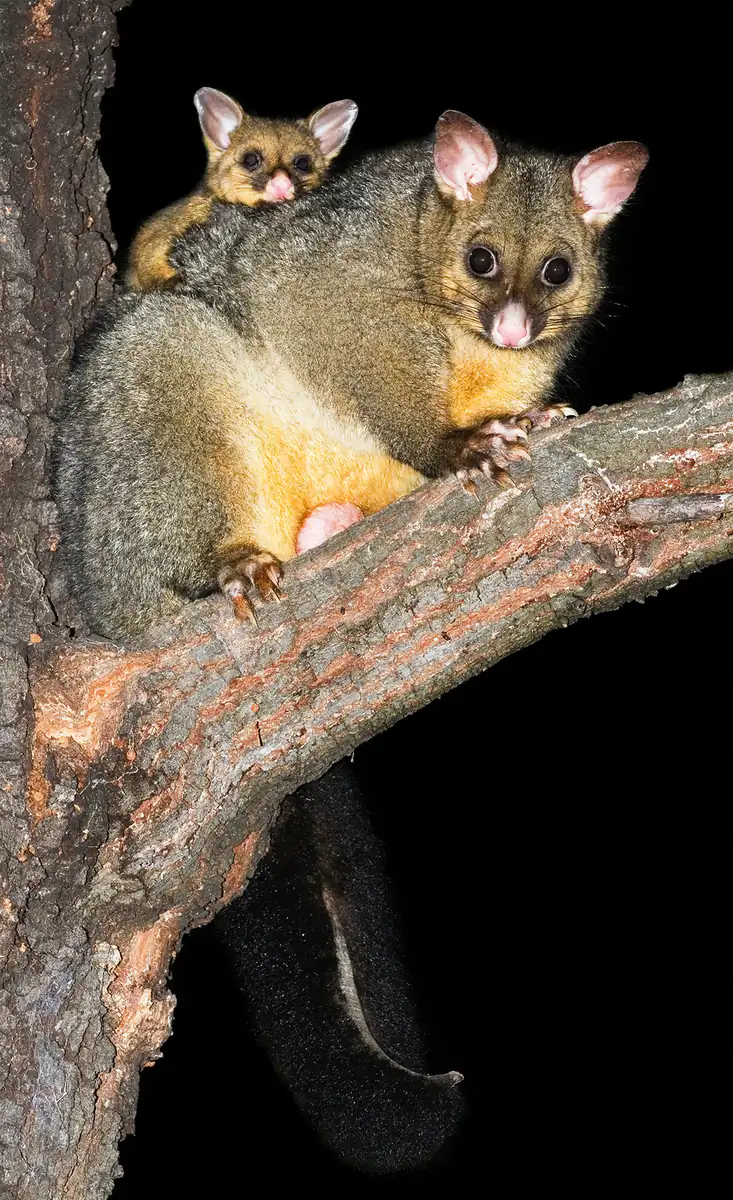
Common Brushtail Possum
Trichosurus vulpecula
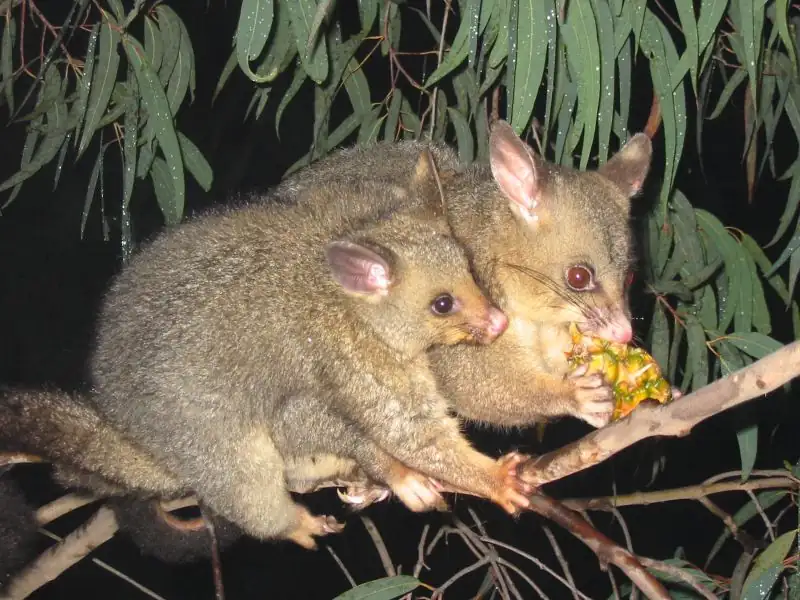
Common Ringtail Possum
Pseudocheirus peregrinus
Signs You Have a Possum in Your Frankston Home
Possums are nocturnal, so you may not see them — but you'll definitely hear and smell them. Here's what to look and listen for in Frankston homes.
Heavy thumping or running sounds
Particularly between 9pm and 4am. Brushtail possums are surprisingly heavy and loud when moving across ceiling joists.
Hissing, screeching or coughing sounds
Brushtails make guttural coughs and loud screeches, especially when disturbed or fighting for territory.
Yellow ceiling stains or ammonia smell
Possum urine soaks through insulation and into plasterboard, leaving brown-yellow stains and a strong, sharp ammonia odour.
Scratch marks on roof tiles or fascia boards
Entry and exit points are often marked with worn timber, broken tiles, or disturbed mortar — look for these at dusk.
Foul dead animal smell
A possum that has died inside your roof will create an intense odour within 48 hours. This requires urgent professional removal.
Damage to garden and fruit trees
Chewed leaves, stripped bark, half-eaten fruit — classic signs of possum foraging activity near your home each night.
🚨 Don't Ignore It
A possum in your roof is not just an annoyance. Left unaddressed, the damage escalates quickly. In Frankston's climate, moisture from possum urine can cause mould, timber rot, and short-circuits within weeks.
Call Now — 1800 482 916The Real Cost of Doing Nothing
Why Possums Are a Serious Risk to Frankston Properties
Frankston's mix of ageing fibro construction and bushland-interface new estates creates distinct damage profiles that require different approaches depending on housing type.
Fibro Eave Structural Collapse
Original fibro eaves from the 1950s-70s are brittle, unsupported, and often rotted at the edges. Possum entry through these weak zones can cause the entire eave section to collapse, requiring full replacement rather than simple repair.
Original Wiring Fire Risk
Frankston's fibro holiday shacks often have original or minimally upgraded electrical wiring. Possum chewing on cable sheathing in these homes creates a critical fire risk in a housing type that is already vulnerable to rapid fire spread through fibro wall and ceiling linings.
Conservation Reserve Spillover Damage
Properties backing onto Frankston Nature Conservation Reserve face constant possum pressure. The re-infestation rate in reserve-interface properties is the highest of any Melbourne suburb unless comprehensive proofing and alternative den provisioning is in place.
Insulation Contamination & Mould
Fibro homes typically have minimal roof insulation, and what exists is often degraded. Possum urine in these low-pitch roof cavities creates mould conditions that spread quickly into living areas through the unsealed ceiling linings common to fibro construction.
Building Inspection Failure Risk
Frankston's older fibro homes are already difficult to insure and sell. Evidence of possum infestation compounds these challenges and can make properties effectively unsaleable without extensive remediation certificates.
Family Sleep Disruption in Estates
Newer estate homes in Frankston South and Karingal have children's bedrooms on upper levels directly below roof cavities. Possum activity at night causes severe disruption to family sleep patterns, which is the primary driver of urgent callouts from these areas.
Common Brushtail in Urban Frankston
The primary species entering roofs
Why Possums Choose Frankston Roofs
Frankston's older housing stock — the 1950s-70s fibro holiday shacks — represents the most structurally vulnerable roof fabric of any Melbourne suburb we service. These homes were built as weekend getaways, not permanent residences, and their roof construction reflects that origin. The eaves are thin fibre-cement sheeting nailed directly to timber battens without any secondary weatherproofing. The fascia boards are untreated pine that has been exposed to coastal salt spray and winter rainfall for five to seven decades. The roof-to-wall junction is often an unsealed gap of 20-50mm where the corrugated roof sheeting simply meets the wall cladding with no flashing, no trim, and no seal. A brushtail possum encountering this type of roof construction does not need to find an entry point — the entire roofline is an entry point. The structural weakness of fibro eaves is the single biggest reason Frankston generates 210 monthly searches for possum removal, and it is the reason that proofing work on Frankston's older homes is consistently the most extensive per property in our Melbourne operation.
The Frankston Nature Conservation Reserve spillover effect creates a fundamentally different dynamic for the newer estates. The reserve is a 60-hectare remnant of the original coastal woodland ecosystem, home to a dense possum population that has been resident for thousands of years. The housing estates built along its boundary since the 1990s are effectively sitting inside the possums' established territory. The conservation reserve provides food, water, and daytime refuge for the possum population, while the adjacent homes provide warm, dry, predator-free roof cavities for denning. The possums are not invading the houses; they are using the houses as an extension of their natural habitat. This means that trapping and removing individual possums from reserve-interface properties is a temporary solution — the vacated territory is filled by another animal from the reserve within days unless the entry points are comprehensively sealed and alternative den sites are provided in the reserve itself. Our Frankston reserve-interface protocol therefore includes mandatory possum box installation in the adjacent reserve vegetation, with the boxes positioned to draw possums away from the roofline rather than towards it.
The tree-to-roof jump network connects both older and newer Frankston. Frankston's backyard tree canopy is among the densest in Melbourne's south-east, dominated by mature eucalypts, paperbarks, and pines that were planted 40-60 years ago when the suburb was first developed. These trees have canopies that extend directly over rooflines at gutter height, providing possums with a leap distance of two metres or less. The jump network is not limited to properties backing onto reserves — Frankston's entire suburban tree canopy is interconnected, meaning possums can travel from the Nature Conservation Reserve through backyard trees to the foreshore vegetation without ever touching the ground. The continuous canopy corridor makes ground-level possum deterrents — motion-activated lights, ultrasonic devices, fence capping — almost entirely ineffective in Frankston. The only reliable solution is sealing the roof fabric at every potential entry point and providing alternative den sites that are more attractive than the roof cavity.
Possum Removal Laws in Victoria
In Victoria, possums are protected under the Wildlife Act 1975. It is illegal to trap, kill, or relocate a possum without a current wildlife controller licence issued by DEECA. In Victoria, trapped brushtail possums must be released on the property where they were captured, no more than 50 metres from the capture site, after sunset on the day of capture. Failure to comply risks prosecution and fines of up to $10,000. All our Frankston technicians hold current DEECA Wildlife Controller Licences.
⚠️ Penalties for illegal possum removal in Victoria include fines up to $10,000. Always use a licensed operator.
DEECA Wildlife Controller Licence
All possum trapping in Frankston requires a Wildlife Controller Licence from DEECA. Our entire Frankston team is fully licensed and regularly audited.
Home Range Release Requirement
Victorian law requires captured possums to be released within their established home range. For Frankston's reserve-interface jobs, we release within the Nature Conservation Reserve or adjacent bushland corridor.
24-Hour Trap Check Rule
DEECA requires all cage traps to be checked within 24 hours of placement. We monitor every Frankston trap daily and document every check as required.
Documentation for Insurance & Sales
We provide full capture and exclusion documentation for every Frankston job — essential for fibro home insurance and property sales where possum damage history may affect valuation.
Our Humane Possum Removal Process in Frankston
Every job follows the same meticulous 6-step process — compliant with Victoria wildlife law, every time.
Free Same-Day Frankston Inspection
We visit your Frankston property, assess the eave and roof fabric condition, check for conservation reserve proximity and tree-to-roof access points, identify possum species and numbers, and provide a written quote — often same day.
DEECA-Licensed Trap Setup
We set approved cage traps in strategic positions within your roof cavity or on the roof surface. All trap locations are documented as required by DEECA.
Daily Monitoring
We check every trap within 24 hours of placement as required under our DEECA licence. You receive a daily update each morning.
Dusk Release Within Home Range
Captured possums are released at dusk in a suitable tree within their home range, in line with Victorian compliance requirements. Frankston Nature Conservation Reserve and the Peninsula foreshore provide ideal release locations.
Comprehensive Roof Sealing
For fibro homes: full eave and roof edge sealing using marine-grade steel mesh and weatherproof cladding. For newer homes: sarking edge reinforcement, gable end sealing, and solar panel bracket exclusion. Guaranteed for 6 months.
Possum Box Installation & Reserve Follow-Up
We install a DEECA-approved nesting box in a suitable tree — mandatory for reserve-interface properties to provide an alternative den site and reduce re-infestation pressure. Extended monitoring recommended for all conservation reserve-adjacent Frankston properties.
Possum Removal — Frankston Fibro Home Reserve Interface
Nepean Highway, Frankston VIC 3199
Two brushtail possums living in the roof cavity of a 1960s fibro holiday shack converted to permanent residence. Property backed onto the Frankston Nature Conservation Reserve. Six entry points identified: three at unsealed fibro eave edges where the roof sheeting met the wall cladding with gaps of 30-50mm, two at rotted timber fascia boards on the north-eastern elevation, and one at an uncapped whirlybird. Possums had been resident for approximately 10 months, with extensive urine damage across 80sqm of ceiling insulation. Fibro eaves in two sections had begun to sag under the weight of possum movement. Children's bedrooms on the eastern side of the property were directly below the most active possum zone.
Same-day inspection with full roof fabric assessment. Dual cage traps set in the roof cavity. Both possums captured on night five and released at dusk in the adjacent Nature Conservation Reserve within legal home range. Full roof fabric remediation: all unsealed fibro eave edges sealed with galvanised steel mesh and weatherproof PVC trim, rotted fascia boards replaced with treated timber, whirlybird capped with stainless steel mesh, and the entire eave line fitted with a continuous exclusion barrier. Insulation replaced across the entire ceiling zone. Two DEECA-approved nesting boxes installed in trees within the conservation reserve boundary, positioned to draw possums away from the property.
Zero re-entry in 18 months. No possum activity detected at any follow-up inspection. Ceiling and eave repairs completed. Property successfully sold 14 months after remediation with no possum-related building inspection issues.
"These possums had been in our roof for almost a year and the smell was unbearable. The fibro construction of our house meant there were gaps everywhere. They didn't just seal the entry points — they essentially rebuilt the entire roofline perimeter. The possum boxes in the reserve were a brilliant idea. We sold the house last year and the building inspector noted the roof exclusion work as a positive feature."
— Louise T., Frankston VIC
Possum Removal Across All Frankston Suburbs
We cover all of Frankston — from Frankston to Frankston South, Karingal and the reserve interface — same-day.
Frankston & Gateway Suburbs
Don't see your suburb? We likely cover it. Call us to confirm.
📞 Call 1800 482 916Our Possum Services in Frankston
We provide a complete range of possum and wildlife management services across Frankston. Each service is performed by our licensed local team.
Possum Removal
Licensed cage trapping and humane dusk release — the right way to remove possums from Frankston roofs.
Possum Removal in Frankston →Possum Proofing
Permanent roof exclusion using professional-grade steel mesh and materials — sealing every Frankston roof entry point.
Possum Proofing in Frankston →Roof Repairs
Full repair of possum-related roof damage — tiles, insulation, timber, and wiring — across all Frankston property types.
Roof Repairs in Frankston →Dead Possum Removal
Same-day emergency removal of deceased possums from Frankston roofs and walls — with full decontamination and odour treatment.
Dead Possum Removal in Frankston →Possum Boxes
Government-approved nesting box installation in Frankston — the most effective way to prevent possums returning to your roof.
Possum Boxes in Frankston →Strata Services
Building-wide possum management for Frankston strata schemes, apartments, and commercial properties — with full OC documentation.
Strata Services in Frankston →We Also Service Other Major Australian Cities
Not in Frankston? Our licensed possum removal teams operate in cities across Australia. Book your local team today.
Possum Removal Frankston — Frequently Asked Questions
Common questions from Frankston homeowners about possum removal.
Possum removal in Frankston typically starts from $220-$350 for a straightforward single-possum job with standard roof access. Fibro homes with extensive eave and roof edge gaps may require more comprehensive sealing. Bushland-interface properties may need possum box installation and extended monitoring. We always provide a written quote before work begins.
Homeowners can See our transparent pricing before booking an inspection. We never add surprise costs once the inspection is complete.
Yes — possums are protected wildlife under Victoria's Wildlife Act 1975 across all of Victoria, including Frankston. It is illegal to trap, kill, or relocate a possum without a DEECA Wildlife Controller Licence. Penalties include fines up to $10,000.
All our Frankston technicians hold current DEECA licences. Licensed possum removal Frankston is designed to meet every Victorian requirement — approved cage traps, daily checks, and dusk release within home range.
Yes — we service all of Frankston, Frankston South, Frankston North and Karingal. Same-day service is available across the Mornington Peninsula gateway. Call us to confirm your address.
Frankston's older fibro holiday shacks were built as weekend getaways, not permanent residences. The roof construction reflects that: thin fibre-cement eaves nailed directly to timber without secondary weatherproofing, untreated pine fascia boards exposed to coastal salt spray, and unsealed 20-50mm gaps between roof sheeting and wall cladding. These construction weaknesses mean a brushtail possum does not need to actively find an entry point — the entire roofline perimeter is effectively open. Fibro homes require the most extensive proofing work of any housing type we service, because the entire eave line needs to be sealed, not just isolated entry points.
Our Frankston team specialises in full fibro roof perimeter sealing. Book your free Frankston inspection today.
Yes, significantly. The Frankston Nature Conservation Reserve is a 60-hectare bushland reserve with a dense, stable possum population. Properties backing onto the reserve are under permanent possum pressure — the vacated territory from any removal is filled by another animal from the reserve within days unless comprehensive proofing and alternative den sites are in place. We always install possum boxes in the reserve vegetation for reserve-interface properties to draw possums away from the roofline. Extended monitoring is also recommended because the re-infestation rate in these properties is the highest of any Melbourne suburb we service.
Our Frankston reserve-interface protocol includes mandatory possum box installation. Book your free Frankston inspection today.
Need Possum Removal in Frankston Today?
Don't spend another sleepless night listening to scratching in your roof. Our Frankston team is ready — same-day bookings available 7 days a week.
DEECA Licensed · Fully Insured · Written Quote · 6-Month Guarantee